DMBS-04 Emerging Trends & Future of Digital Business
On This Page
Artificial Intelligence & Automation
- Artificial Intelligence (AI) is a technology that enables machines or computer systems to perform tasks that normally require human intelligence. These tasks include learning, reasoning, decision-making, problem solving, and understanding language.
- Automation refers to the use of technology to perform tasks automatically with minimal human intervention.
- When AI is combined with automation, systems can make intelligent decisions and perform tasks without continuous human control.
- In digital business, AI and automation help companies improve efficiency, reduce costs, and provide better services to customers.
Key Concepts of Artificial Intelligence
- Machine Learning:
- Machine Learning is a subset of AI where systems learn from data and improve their performance over time without being explicitly programmed.
- Example: Netflix uses machine learning to recommend movies and shows based on users’ viewing history.
- Natural Language Processing (NLP):
- This technology allows computers to understand and respond to human language.
- Example: Chatbots used in customer service on websites understand user questions and provide automatic responses
- Computer Vision:
- Computer vision allows computers to identify objects, faces, and patterns in images and videos.
- Example: Face recognition systems used in smartphones and airports.
- Robotics:
- Robotics combines AI with physical machines to perform tasks automatically.
- Example: Industrial robots used in automobile manufacturing plants.
Automation in Digital Business
- Automation helps businesses perform repetitive tasks automatically. It improves speed, accuracy, and productivity.
- Examples:
- Automatic email marketing systems
- Automated billing and payment processing
- Customer support chatbots
- Automated inventory management
- Real Time Examples:
- Amazon Warehouse: Amazon uses AI-powered robots to move products inside warehouses. These robots automatically locate products, bring them to workers, and speed up delivery processes.
- Banking Sector: Banks use AI chatbots to answer customer queries related to account balance, transactions, and loan information.
- Healthcare: AI systems help doctors analyze medical images like X-rays and detect diseases such as cancer.
Benefits of AI and Automation
- Faster decision making
- Reduced human errors
- Increased productivity
- Better customer service
- Cost reduction
Challenges of AI
- Job displacement due to automation
- High implementation cost
- Data privacy concerns
- hical issues in AI decision making
Big Data & Analytics
- Big Data refers to extremely large and complex datasets that cannot be processed using traditional data processing systems.
- Organizations generate huge amounts of data every day from sources like social media, online transactions, sensors, and websites.
- Big Data analytics helps organizations analyze this data to gain useful insights for decision making
- Types of analytics:
- Descriptive Analytics: Analyzes past data to understand what happened. For example Sales reports showing last year's revenue.
- Predictive Analytics: Uses historical data to predict future outcomes. For example Predicting customer demand for products.
- Prescriptive Analytics: Suggests actions to achieve better results. For example Recommending optimal pricing strategies.
Characteristics of Big Data
- Volume: Large quantity of data generated every second
- Velocity: Speed at which data is generated and processed
- Veracity: Accuracy and reliability of data
- Value: The usefulness of data for decision making
- Variety: Different types of data such as text, images, videos, and audio
Real Time Examples
- E-Commerce Platforms: Companies like Amazon analyze customer browsing history to recommend products.
- Healthcare: Hospitals analyze patient data to predict disease outbreaks and improve treatment plans.
- Transportation: Ride-sharing companies analyze traffic and location data to optimize routes and pricing
Cloud Computing & Digital Transformation
- Cloud computing is a technology that allows users to store, manage, and access data and applications over the internet instead of using local computers or servers.
- Digital transformation refers to the integration of digital technologies into business processes to improve operations and services.
Types of Cloud Services
- Infrastructure as a Service (IaaS): Provides virtual computing resources such as servers and storage. For example Amazon Web Services (AWS)
- Platform as a Service (PaaS): Provides a platform for developers to build and deploy applications. For example Google App Engine
- Software as a Service (SaaS): Provides software applications through the internet. For example Google Docs, Microsoft 365
Real Time Examples
- Google Drive Allows users to store and access files from anywhere using the internet.
- Online Education Platforms Platforms like Coursera and Udemy store course materials on cloud servers.
- Business Collaboration Companies use cloud tools like Microsoft Teams for remote collaboration.
Ethical & Legal Issues in Digital Marketing
- Digital marketing involves collecting data, targeting users, and promoting products online. While it offers many benefits, it also raises ethical (moral) and legal (law-based) concerns.
- Companies collect user data (name, email, browsing behavior).
- Ethical concern is how safely and transparently this data is used
- Legal Aspect:
- Laws like GDPR (General Data Protection Regulation) and Information Technology Act 2000
- Require user consent before data collection
- Ethical Practice:
- Take clear consent
- Protect data from misuse
Cybersecurity Challenges in e-Business
- Ecommerce businesses face a multitude of cybersecurity challenges that threaten the integrity and trust of online businesses.
- These challenges include:
- Rising Threats of AI Powered Cyber attacks: Cybercriminals are leveraging AI to develop sophisticated attack methodologies, making it harder to detect and neutralize threats.
- Increased Ransomware Attacks: Ransomware remains one of the most lucrative forms of cybercrime, with attackers targeting Ecommerce businesses for their vast volumes of sensitive customer data.
- Social Engineering: Scammers impersonate Ecommerce brands and manipulate customers into clicking links or providing personal information
- Financial Fraud: Cyber criminals exploit weaknesses in business processes and security systems to inflict financial harm on businesses and consumers.
- Malware: Breach software, including viruses and spyware, poses significant risks to e-commerce platforms.
- Ecommerce businesses must implement robust security measures to protect their digital assets and maintain the integrity of their operations
- This includes adopting AI powered security systems, continuously updating security protocols, and educating employees on recognizing AI generated phishing emails and social engineering tactics
Future Trends: Voice Commerce
- Voice commerce (v-commerce) is one of the fastest-growing trends in digital business, allowing users to search, select, and purchase products using voice commands through AI assistants like Alexa, Siri, or Google Assistant.
- Here are the key future trends:
- Conversational AI (Natural Interaction):
- Voice systems are moving from command-based to conversation-based.
- Users can speak naturally like: “Find me budget-friendly shoes under ₹3000”
- AI understands intent, preferences, and follow-up questions.
- Personalized Shopping Experience:
- Voice assistants use AI + past data to recommend products.
- Suggestions are based on: Previous purchases, Preferences, Behavior patterns
- Leads to higher customer satisfaction and sales.
- Multilingual & Local Language Support:
- Voice commerce is expanding globally with: Support for regional languages
- Makes technology more inclusive and accessible
- Context-Aware & Smart Assistants:
- Systems remember: Your previous orders, Location, Time
- Example: “Reorder my usual groceries”
- Creates a seamless shopping experience
- Agentic Commerce (AI Takes Action):
- AI doesn’t just assist—it acts on behalf of users
- Auto reordering products
- Tracking price drops
- Completing purchases
- Represents a shift toward automation-driven commerce
- Multimodal Experience (Voice + Screen):
- Integration of voice + visual interfaces (smart displays, mobiles)
- Users can: Speak → Search, See → Compare, Tap → Buy
- Overcomes limitations of voice-only systems.
- Rapid Market Growth:
- Voice commerce is expected to become a multi-billion dollar market
- Projected to reach $100B+ by 2026 and grow further.
- Hands-Free & Convenience-Driven Shopping:
- Ideal for: Driving, Cooking, Multitasking, Faster than typing → increases adoption.
- Improved Security & Privacy Features:
- Future systems will include: Voice authentication, Biometric verification, Address concerns of unauthorized purchases.
- Growth in Specific Use Cases:
- Voice commerce will dominate in: Reordering daily items, Checking order status, Quick purchases
- Conversational AI (Natural Interaction):
AR/VR in marketing
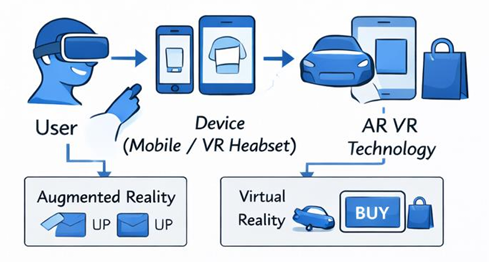
- AR (Augmented Reality) and VR (Virtual Reality) are transforming marketing by creating immersive, interactive, and engaging customer experiences that go beyond traditional advertising
- AR → Adds digital elements to the real world (via mobile/camera)
- VR → Creates a fully virtual environment (via headsets)
Key Uses of AR/VR in Marketing
- Virtual Try-On & Product Visualization:
- Customers can: Try clothes, glasses, makeup virtually
- See how furniture fits in their home
- Reduces uncertainty and increases purchase confidence
- Immersive Brand Experience:
- Brands create virtual showrooms or stores
- Customers can explore products in a 3D environment
- Example: Virtual car showrooms, real estate tours
- Interactive Advertising:
- Ads become engaging and interactive
- Users can: Scan a product → View 3D model & Interact with brand content
- Increases customer engagement and retention
- Virtual Events & Product Launches:
- Companies host: Virtual product launches, Online exhibitions, Saves cost and reaches a global audience
- Social Media AR Filters:
- Platforms like Instagram and Snapchat use AR filters: Face filters, Branded effects
- Helps brands go viral and increase visibility
- Enhanced Customer Engagement
- AR/VR makes marketing: Fun, Memorable, Leads to stronger brand connection
- Better Decision Making:
- Customers can visualize products before buying
- Reduces returns and improves satisfaction
Metaverse in Marketing
- The Metaverse is a virtual, immersive digital world where users interact through avatars, combining technologies like AR, VR, AI, and blockchain.
- It is emerging as a powerful platform for next generation marketing and business
Role of Metaverse in Marketing
- Virtual Stores & Showrooms:
- Brands create digital stores in the metaverse
- Customers can: Walk through stores, Explore products in 3D
- Example: Virtual malls and fashion stores
- Digital Products & Virtual Goods:
- Selling virtual items like: Clothes for avatars, Accessories
- New revenue streams for brands
- Gamification Marketing:
- Brands use games to promote products
- Users engage through: Challenges, Rewards, Increases engagement and brand loyalty
- Virtual Events & Experiences:
- Companies organize: Concerts, Product, Exhibitions
- Example: Virtual concerts inside Fortnite
- Social Interaction & Community Building:
- Users interact with brands and communities
- Builds strong emotional connection with customers
- Blockchain & Digital Ownership:
- Use of NFTs (Non-Fungible Tokens): Unique digital assets, Proof of ownership
- Enables secure buying/selling in the metaverse
Blockchain in E-Business
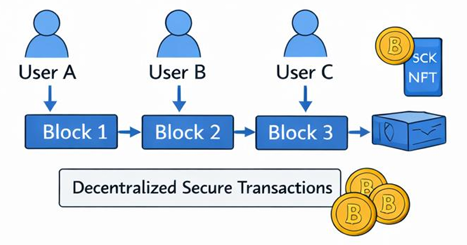
- Blockchain is transforming e business by enabling secure, transparent, and digital efficient transactions, particularly in e-commerce, supply chain management, and customer trust-building.
- Its decentralized ledger reduces fraud, enhances security, and streamlines operations businesses worldwide.
Key Uses of Blockchain in E-Business
- Secure Transactions: Blockchain ensures safe and tamper-proof online payments without intermediaries, reducing fraud.
- Transparency & Trust: All transactions are recorded and visible to authorized users, increasing trust between buyers and sellers.
- Smart Contracts: Self-executing contracts automatically perform actions when conditions are met, reducing manual work and delays.
- Supply Chain Management: Helps track products from origin to delivery, ensuring authenticity and reducing counterfeiting.
- Reduced Costs: Eliminates middlemen like banks, lowering transaction and processing costs.