MLDNN-03 Introduction to Deep Learning
On This Page
Deep Learning (DL)
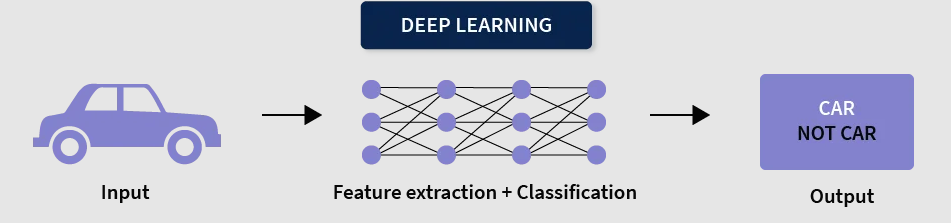
- Deep Learning is a subset of Machine Learning that uses artificial neural networks with multiple layers to learn from data.
- It is inspired by the structure of the human brain and is capable of learning complex patterns automatically.
- It works especially well with large datasets and complex problems.
How Deep Learning Works
- Deep learning models consist of multiple layers: input layer, hidden layers, and output layer.
- The input layer receives raw data such as images, text, or audio.
- Hidden layers process the data and extract important features step by step.
- The output layer gives the final prediction or result.
- Each layer learns more complex patterns than the previous one.
Key Features of Deep Learning
- Uses multi-layer neural networks (deep neural networks).
- Automatically extracts features from raw data.
- Handles large and complex datasets efficiently.
- Provides high accuracy for tasks like image and speech recognition.
Applications of Deep Learning in Real-World Domains
1. Healthcare
- Deep Learning is widely used in medical diagnosis and treatment planning.
- It helps in analyzing medical images such as X-rays, MRIs, and CT scans to detect diseases.
- It can identify patterns that are difficult for humans to detect.
- Example: Detecting tumors, predicting diseases like cancer, and assisting doctors in diagnosis.
2. Finance
- Deep Learning is used in the finance sector for fraud detection and risk analysis.
- It analyzes large amounts of transaction data to identify unusual patterns.
- It helps in making better investment decisions and predicting market trends.
- Example: Detecting fraudulent credit card transactions and predicting stock price movements.
3. Computer Vision
- Computer Vision is a field where machines interpret and understand visual data like images and videos.
- Deep Learning helps in recognizing objects, faces, and scenes accurately.
- It is used in security systems, automation, and image processing.
- Example: Face recognition systems, self-driving cars, and object detection in images.
4. Natural Language Processing (NLP)
- Deep Learning helps machines understand and process human language.
- It is used in translation, chatbots, and text analysis.
- Example: Language translation apps and virtual assistants.
5. Speech Recognition
- Deep Learning converts speech into text and understands voice commands.
- Example: Voice assistants like Siri and Google Assistant.
Artificial Neural Network (ANN)
- An Artificial Neural Network (ANN) is a computational model inspired by the human brain.
- It consists of interconnected nodes (neurons) that process information.
- ANN is used to recognize patterns, learn from data, and make predictions.
Basic Structure of ANN
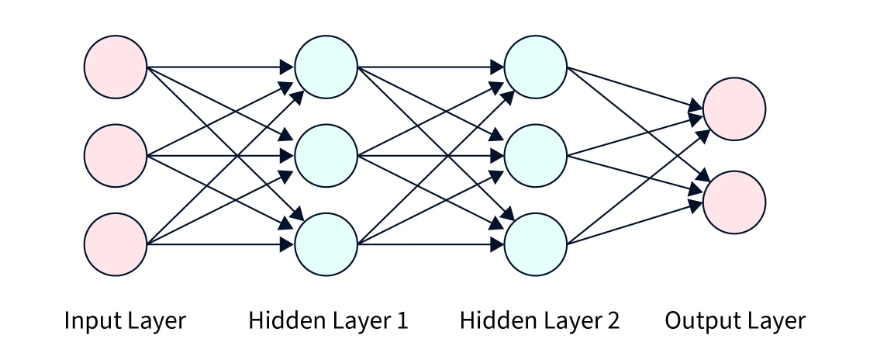
1. Input Layer
- This layer receives the input data from the outside world.
- Each neuron represents a feature of the data.
2. Hidden Layer(s)
- These layers process the input data.
- They perform calculations and extract important patterns.
- There can be one or multiple hidden layers in a network.
3. Output Layer
- This layer produces the final result or prediction.
- It gives the output in the required format (e.g., class label or value).
Working of ANN
- Input data is passed to the input layer.
- Each neuron multiplies the input by a weight and adds a bias.
- The result is passed through an activation function.
- The processed data moves through hidden layers.
- Finally, the output layer produces the result.
- The network learns by adjusting weights and biases to reduce error.
Example
- In image recognition, the input layer receives pixel values.
- Hidden layers detect features like edges and shapes.
- The output layer identifies the object (e.g., cat or dog).
Components of a Neuron in an ANN
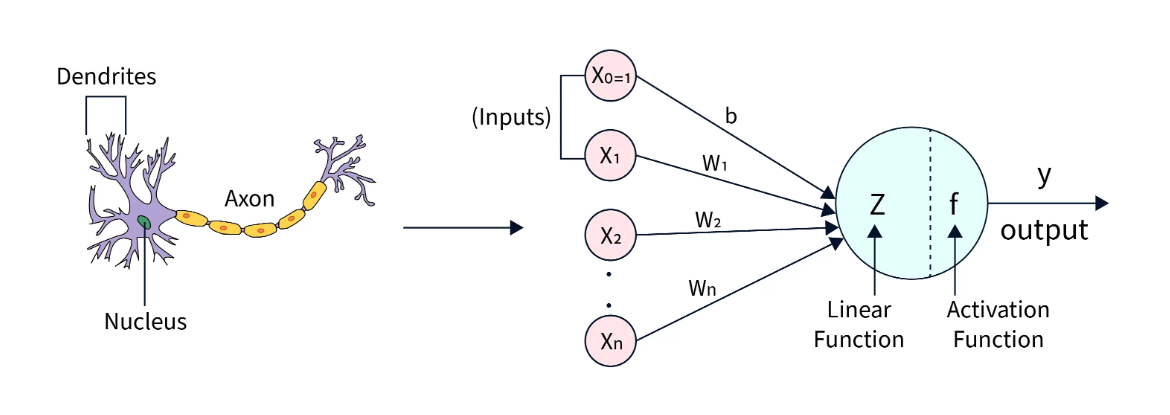
1. Inputs (x₁, x₂, …, xₙ)
- These are the input values or features provided to the neuron.
- They represent the data that the model receives.
2. Weights (w₁, w₂, …, wₙ)
- Each input is multiplied by a weight that represents its importance.
- Higher weight means greater influence on the output.
3. Bias (b)
- Bias is an additional value added to the weighted sum.
- It helps in shifting the output and improving model performance.
4. Weighted Sum (z)
- It is the sum of all inputs multiplied by their weights plus bias:
z = w₁x₁ + w₂x₂ + ... + wₙxₙ + b
5. Activation Function
- It decides whether the neuron should be activated or not.
- It converts the weighted sum into the final output.
6. Output (y)
- The final result produced by the neuron after applying the activation function.
Perceptron Model
- The Perceptron is the simplest form of an Artificial Neural Network.
- It is a single-layer neural network used for binary classification (Yes/No, 0/1).
- It takes input values, processes them, and produces an output based on a decision rule.
Structure of Perceptron
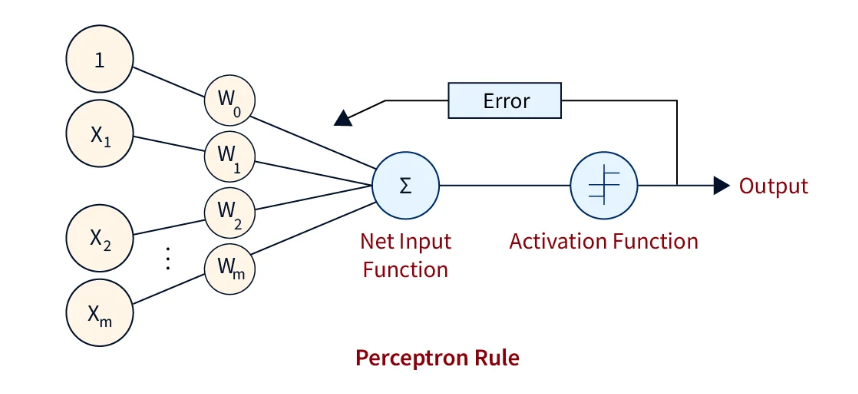
- It consists of input values, weights, bias, and an activation function.
- Each input is assigned a weight that represents its importance.
- A bias is added to adjust the final output.
- The activation function decides the final result.
Mathematical Representation
The perceptron calculates a weighted sum of inputs:
-
z = w1x1 + w2x2 + w3x3 + ... + bThe output is then passed through an activation function: -
y = f(z)For a simple step function:- If
z ≥ 0→ Output = 1 - If
z < 0→ Output = 0
- If
Explanation of Terms
- x₁, x₂, …, xₙ (Inputs): These are the input features given to the model.
- w₁, w₂, …, wₙ (Weights): These represent the importance of each input.
- b (Bias): A constant value added to shift the decision boundary.
- z (Weighted Sum): The combined value of inputs and weights plus bias.
- f(z) (Activation Function): Determines the final output based on z.
- y (Output): The final prediction (0 or 1).
Working of Perceptron
- Input values are multiplied by their respective weights.
- All values are added together along with bias.
- The result (z) is passed to the activation function.
- The activation function produces the final output (0 or 1).
- The model learns by adjusting weights when predictions are incorrect.
Example
- Predict whether a student will pass or fail:
- Inputs: study hours, attendance
- Output: Pass (1) or Fail (0)
- The perceptron combines inputs and makes a decision based on a threshold.
Activation Functions
- An activation function is a mathematical function used in neural networks to decide whether a neuron should be activated or not.
- It takes the weighted sum of inputs (including bias) and converts it into an output signal.
- It controls how much information should pass to the next layer in the network.
- Activation functions help the network learn and represent complex patterns in data.
Why it is Important
- It introduces non-linearity, which allows neural networks to learn complex and real-world relationships.
- Without activation functions, the network would behave like a simple linear model and cannot solve complex problems.
- It helps neurons decide whether to activate based on input values.
- It improves the learning ability and accuracy of the model.
- It enables deep neural networks to learn multiple levels of abstraction (from simple to complex features).
- It allows the network to handle tasks like image recognition, speech processing, and classification effectively.
Example
- In image recognition, activation functions help detect edges, shapes, and objects step by step.
- Without activation functions, the network would not be able to distinguish between complex patterns in images.
1. Sigmoid Function
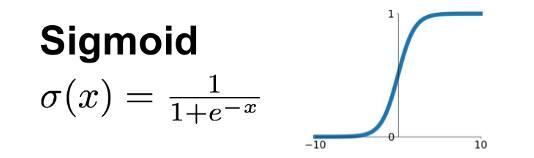
- The sigmoid function gives output values between 0 and 1.
- It is mainly used for binary classification problems.
- Formula:
f(x) = 1 / (1 + e⁻ˣ) - Example: Predicting whether an email is spam or not.
2. Tanh Function
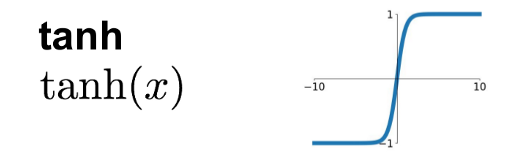
- The tanh function gives output values between -1 and +1.
- It is zero-centered, which helps in better learning compared to sigmoid.
- Example: Sentiment analysis (positive, negative, neutral).
3. ReLU (Rectified Linear Unit)
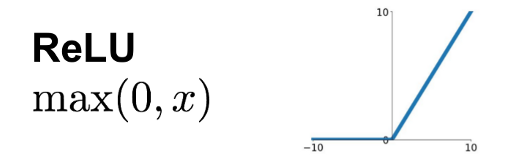
- ReLU outputs 0 if the input is negative, otherwise it returns the input value.
- It is simple, fast, and widely used in deep learning models.
- Formula:
f(x) = max(0, x) - Example: Used in hidden layers of neural networks.
4. Softmax Function
- Softmax converts values into probabilities that sum to 1.
- It is used in multi-class classification problems.
- Example: Classifying an image as cat, dog, or bird.
Softmax Activation Function & its Role in Multi-Class Classification
- Softmax is an activation function used in neural networks for multi-class classification problems.
- It converts raw output values (logits) into probabilities.
- The output values are in the range of 0 to 1, and their total sum is always equal to 1.
How Softmax Works
- It takes multiple input values and applies an exponential function to each.
- Then, each value is divided by the sum of all exponential values.
- This produces a probability distribution over all classes.
Role in Multi-Class Classification
- Softmax helps the model decide which class is most likely among multiple options.
- Each output neuron represents one class.
- The class with the highest probability is selected as the final prediction.
Example
- Suppose a model classifies an image as:
- Cat → 0.7
- Dog → 0.2
- Rabbit → 0.1
- The model predicts "Cat" because it has the highest probability.
Optimization in Deep Learning
- Optimization is the process of improving a deep learning model by reducing its error (loss).
- It involves adjusting the model’s weights and biases to make better predictions.
Why Optimization is Necessary
- Initially, the model makes incorrect predictions due to random weights.
- Optimization helps the model learn from errors and improve accuracy step by step.
- It minimizes the loss function, which measures the difference between predicted and actual values.
- Without optimization, the model cannot learn or improve its performance.
How it Works
- The model makes predictions and calculates the loss.
- An optimization algorithm (like gradient descent) updates the weights.
- This process is repeated until the loss is minimized.
Example
- It is like improving your exam score by correcting mistakes after each test.
- With each correction, your performance becomes better.
Gradient Descent
- Gradient Descent is an optimization algorithm used in Machine Learning and Deep Learning to minimize the error (loss) of a model.
- It works by adjusting the model’s weights step by step so that the predictions become closer to the actual values.
- The main goal is to find the best values of parameters that give minimum loss.
Basic Idea
- Imagine the error as a curve (loss function).
- Gradient Descent tries to find the lowest point on this curve.
- It moves step by step in the direction where the error decreases the most.
How Gradient Descent Works
1. Initialize Parameters
- The model starts with random values of weights.
2. Calculate Loss
- The model makes predictions and compares them with actual values.
- The difference between them is called loss or error.
3. Compute Gradient
- The gradient tells how much and in which direction the weights should change to reduce error.
4. Update Weights
- Weights are updated in the opposite direction of the gradient.
- This step is controlled by a parameter called learning rate.
5. Repeat Process
- Steps are repeated until the loss becomes very small or stops decreasing.
Simple Example
- Imagine you are trying to reach the bottom of a hill in the dark.
- You cannot see the whole path, so you take small steps downward.
- At each step, you check the slope and move in the direction where the ground goes down.
- Eventually, you reach the lowest point.
- Similarly, Gradient Descent adjusts weights step by step to reach minimum error.
Key Points
- Learning rate controls how big each step is.
- Too large learning rate may skip the minimum point.
- Too small learning rate makes learning slow.
Differences between AI, ML, and DL
| Aspect | AI (Artificial Intelligence) | ML (Machine Learning) | DL (Deep Learning) |
|---|---|---|---|
| Nature of Technology | General concept of creating intelligent systems | Technique enabling machines to learn from data | Advanced technique based on neural networks |
| Working Style | Uses rules, logic, and learning methods | Uses statistical algorithms to learn patterns | Uses layered neural networks to learn automatically |
| Feature Handling | May rely on predefined rules | Requires manual feature selection | Automatically extracts features from raw data |
| Data Type Handling | Works with simple or structured data | Mainly works with structured data | Handles complex unstructured data (images, audio, text) |
| Performance Level | Moderate, depends on system design | Good with proper data | High for complex, large-scale problems |
DL in Image Recognition
- Deep Learning uses neural networks, especially Convolutional Neural Networks (CNNs), to analyze and understand images.
- The model processes images through multiple layers to extract features step by step.
- In the initial layers, simple features like edges, lines, and colors are detected.
- In deeper layers, complex patterns such as shapes, textures, and objects are identified.
- The final layer classifies the image into categories based on learned patterns.
- This approach allows the system to automatically learn features without manual programming.
- Example: Face recognition in smartphones, object detection in images, and handwriting recognition.
DL in Natural Language Processing (NLP)
- Deep Learning is used to process and understand human language in both text and speech form.
- It uses models like Recurrent Neural Networks (RNNs) and Transformers to capture context and meaning.
- The system learns patterns in language such as grammar, sentence structure, and word relationships.
- It can perform tasks like translation, text generation, sentiment analysis, and question answering.
- Deep Learning enables machines to understand context rather than just individual words.
- Example: Language translation (English to Hindi), chatbots, virtual assistants, and text summarization.
Differentiate between Batch Gradient Descent, Stochastic Gradient Descent, and Mini-Batch Gradient Descent.
Batch Gradient Descent
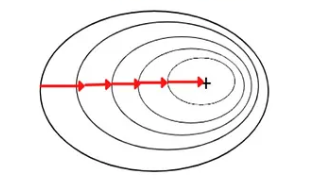
- Batch Gradient Descent uses the entire dataset to compute the gradient in each iteration.
- It calculates the average error over all training examples before updating weights.
Advantages
- Provides stable and accurate updates.
- Converges smoothly towards the minimum.
Disadvantages
- Slow for large datasets.
- Requires high memory and computation power.
Stochastic Gradient Descent (SGD)
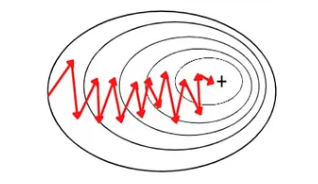
- Stochastic Gradient Descent updates weights using one data point at a time.
- It performs frequent updates after each training example.
Advantages
- Faster and requires less memory.
- Can escape local minima due to random updates.
Disadvantages
- Updates are noisy and less stable.
- May not converge smoothly to the exact minimum.
Mini-Batch Gradient Descent
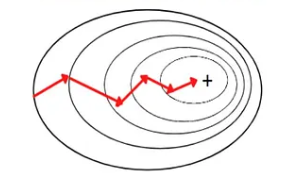
- Mini-Batch Gradient Descent uses a small subset (batch) of data to update weights.
- It is a combination of Batch and Stochastic Gradient Descent.
Advantages
- Faster than batch and more stable than SGD.
- Efficient for large datasets and widely used in practice.
Disadvantages
- Requires choosing appropriate batch size.
- Performance depends on batch size selection.
| Aspect | Batch Gradient Descent | Stochastic Gradient Descent (SGD) | Mini-Batch Gradient Descent |
|---|---|---|---|
| Approach | Uses entire dataset per update | Uses one data point per update | Uses small subset (batch) per update |
| Gradient Calculation | Average error over all training examples | Error from single example | Average error over batch |
| Speed | Slow | Fast | Moderate and efficient |
| Memory Usage | High | Low | Moderate |
| Stability | High (smooth convergence) | Low (noisy updates) | Balanced stability |
| Convergence | Smooth, accurate | Fluctuates, less precise | Faster and relatively stable |
| Handling Large Data | Not suitable | Suitable | Highly suitable |
| Advantages | Stable, accurate updates | Fast, low memory, escapes local minima | Balanced speed and stability, widely used |
| Disadvantages | Slow, computationally expensive | Noisy, unstable convergence | Depends on batch size selection |
| Data per Update | Entire dataset | One data point | Small batch |
| Typical Usage | Small datasets | Online learning | Deep learning (most common) |
A neuron receives inputs 0.5 and 0.8 with weights 0.4 and 0.6 respectively. Calculate the output using Sigmoid activation (assume bias = 0).
Step 1: Calculate Weighted Sum (z)
-
Formula:
z = (w₁x₁ + w₂x₂ + b) -
Given:
x₁ = 0.5, w₁ = 0.4x₂ = 0.8, w₂ = 0.6b = 0
-
Calculation:
z = (0.4 × 0.5) + (0.6 × 0.8) + 0z = 0.2 + 0.48z = 0.68
Step 2: Apply Sigmoid Function
- Formula:
σ(z) = 1 / (1 + e⁻ᶻ) - Substitute z = 0.68:
σ(0.68) = 1 / (1 + e⁻⁰·⁶ - Approximate value:
e⁻⁰·⁶⁸ ≈ 0.506 - Final calculation:
σ(0.68) = 1 / (1 + 0.506)σ(0.68) ≈ 1 / 1.506σ(0.68) ≈ 0.664
Final Output: The output of the neuron using Sigmoid activation is approximately 0.66.